



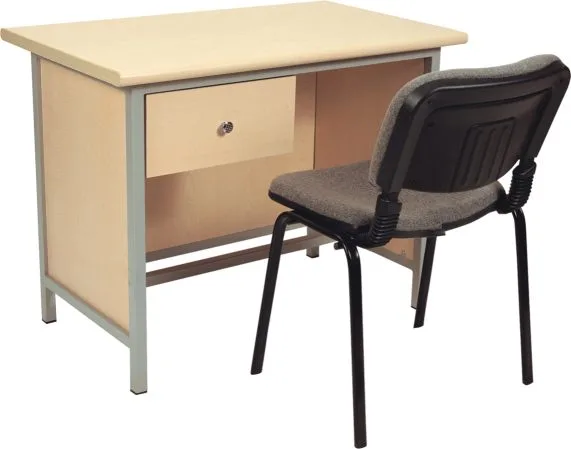
Standard Teacher Desk
Product Code: MS 30
Standard teacher desk: 18 mm melamine body, box profile skeleton, lockable drawer, open shelf and closed side panels. For the classic classroom. Code MS 30.
- Product code
- MS 30
- Body material
- 18 mm melamine panel
- Skeleton
- Electrostatic powder-coated rectangular box profile
Free project survey Custom, quote-based pricing TSE / ISO 9001 certified production
Key Features
- Lockable drawer — examination paperwork and student records stay safely at the desk
- Closed side and rear panels — the space under the desk becomes a real storage volume
- Lockable drawer plus open shelf — material separated by security requirement
- 18 mm melamine body — a balanced thickness between durability and weight
- Rectangular box profile skeleton — high resistance to bending
- Closed melamine surface — ink, chalk dust and liquid do not soak in
- Standardised production — the same solidity at a more accessible cost
- Panel replacement and skeleton repair are standard workshop work
Product Description
The Standard teacher desk, with its 18 mm melamine panel body, box profile skeleton and lockable drawer, is the most widely used teacher desk in the classic classroom arrangement. Because the side and rear panels are closed, it offers markedly more enclosed storage space than other models. It is the right choice for schools looking for a solid melamine teacher desk and needing storage at the desk.
The lockable drawer: why does it matter?
The clearest difference between this model and other teacher desks is that the drawer locks. The teacher desk is where the paperwork requiring security is most often found in a school: examination questions, answer keys, mark books, student records. All of it waits at the desk during the moments between lessons when the room is empty.
A lockable drawer solves that problem directly. The teacher does not have to gather the paperwork and take it to their room when leaving; the drawer is locked and the desk stays where it is. During examination periods that is a concrete convenience for both security and practicality. Given the obligation to protect personal data as well, being able to keep student records physically under lock becomes an institutional requirement.
The lock also offers a solution for the teacher’s personal belongings. A teacher without a cupboard in their classroom has to carry their bag and personal items around all day; a lockable drawer removes that burden. Although it may not look like a technical property of the product, it is one of the points we receive the most feedback on in daily use. Tying key management to a defined procedure set by the school administration matters for the drawer keeping its function over the long term.
Box profile skeleton and closed side panels
The skeleton is produced from rectangular-section box profile and meets the floor at four corners. At the same wall thickness, box profile shows higher resistance to bending than round profile; because the wide edge of the section sits perpendicular to the direction the load arrives from, the body behaves more rigidly.
The side and rear faces are closed with melamine panels. That turns the space under the desk into a volume closed on three sides and produces two results: material placed under the desk is not visible from the room, and that volume becomes a real storage area. On open-bodied desks that area cannot be used, because everything put into it stays visible.
Storage volume and open shelf
Beside the lockable drawer there is an open shelf compartment. That pairing makes it possible to separate material by security requirement: frequently used items not requiring security stay in easy reach on the open shelf, while paperwork and personal belongings are kept in the lockable drawer.
Storage is a more decisive item on a teacher desk than it appears. For teachers without a cupboard in their classroom, the desk is the only place of storage; teaching material, spare pens, the projector remote, cleaning supplies and personal items all have to fit in the same place. A desk with an enclosed volume meets that need; an open-bodied desk does not.
That need also varies with the type of school. In buildings where each classroom has its own cupboard, the only thing expected from the desk may be a working surface; whereas in schools with no cupboards, or where subject teachers move between rooms, the desk becomes the only fixed point where material carried around all day can be left. Share your cupboard situation per classroom and we can plan together which desk should go to which room — one of those decisions that looks unimportant at first and is felt for years.
18 mm melamine body
The body panels are 18 mm melamine. That thickness is the balanced point between durability and weight in panel furniture: thinner panels flex under load and cause loosening at connection points, while thicker panels make the desk unnecessarily heavy. The melamine surface is closed; ink, chalk dust and spilled liquid do not soak in and it is cleaned by wiping with a damp cloth. On panel-bodied desks the critical point is the corners where the panels join one another; when those connections are built solidly the body behaves as one piece, and when they loosen the desk starts to move as a whole.
Economy for the classic classroom
This desk is a product of low design complexity and standardised production. The direct result is that it can offer the same level of solidity at a more accessible cost. In projects furnishing a large number of classrooms across a school, the relationship between unit cost and total budget quickly becomes decisive; that is exactly the scenario in which this model is most often chosen.
Simplicity brings an advantage on the maintenance side too. Unlike bodies requiring complex moulds, a panel replacement or a skeleton repair here is standard workshop work.
In state schools the service life of furniture often exceeds what was projected; under those conditions repairability becomes more decisive than initial investment cost. A body not dependent on a special mould or manufacturer can be kept standing even ten years later. The reason this model has been used in schools for so long is not that its design is striking but exactly this way of enduring.
Ordering and delivery
Melamine panel colour, skeleton colour, drawer and shelf configuration and quantity are determined on the order. Production in one batch across the school preserves colour consistency. Our survey service is free of charge; when you share your classroom count and existing arrangement we work out the suitable configuration. The delivery charge is calculated according to order volume and destination province, appears as a separate item in the quotation and is not included in the product price.
Models and Variants
| Model | Code | Description |
|---|---|---|
| Standard — Lockable Drawer + Open Shelf | MS 30 | The basic configuration. Paperwork requiring security in the lockable drawer, frequently used material on the open shelf. |
| Standard — Wood-Tone Panel | MS 30 | Light wood-toned melamine panels suited to the classic classroom atmosphere. |
| Standard — Bulk Project Build | MS 30 | Production in one batch on projects furnishing many classrooms at once; colour consistency and a unit cost advantage. |
Frequently Asked Questions
Does the drawer really lock?
Yes, and this is the clearest difference between this model and other teacher desks. Examination questions, answer keys, mark books and student records wait at the desk when the room is empty between lessons; a lockable drawer keeps that paperwork in place and secure.
Why have closed side panels been chosen?
When the side and rear faces are closed with melamine panel, the space under the desk becomes a volume closed on three sides. That produces two results: material placed there is not visible from the room, and the area becomes a real storage volume. On open-bodied desks that area cannot be used in practice.
How much storage does it offer?
Beside the lockable drawer there is an open shelf compartment. For teachers without a cupboard in their classroom the desk is the only place of storage; teaching material, spare pens, the projector remote and personal items collect in that volume. Items requiring security stay in the drawer, frequently used ones on the open shelf.
Is 18 mm panel thickness sufficient?
That is the balanced point between durability and weight in panel furniture. Thinner panels flex under load and cause loosening at connection points; thicker panels make the desk unnecessarily heavy and harder to move.
What is different about the box profile skeleton?
At the same wall thickness, rectangular box profile shows higher resistance to bending than round profile; the wide edge of the section sits perpendicular to the direction the load arrives from and the body behaves more rigidly.
Why is this model more economical?
It is a product of low design complexity and standardised production; it offers the same level of solidity at a more accessible cost. In projects furnishing a large number of classrooms across a school, the relationship between unit cost and total budget quickly becomes decisive.
Can it be repaired if damaged?
Simplicity is an advantage on the maintenance side. Unlike bodies requiring complex moulds, a panel replacement or a skeleton repair here is standard workshop work; there is no need to wait for a special part.
Other Groups in the Same Category
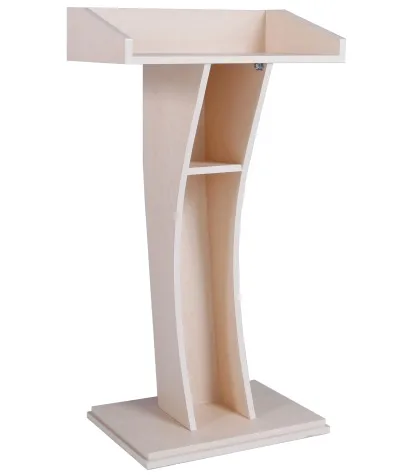
Wooden Speaker's Lectern
Wooden speaker's lectern: 18 mm MDF-lam body, forward-sloping reading surface and an internal lower shelf. For conference, ceremony and protocol areas. Code…
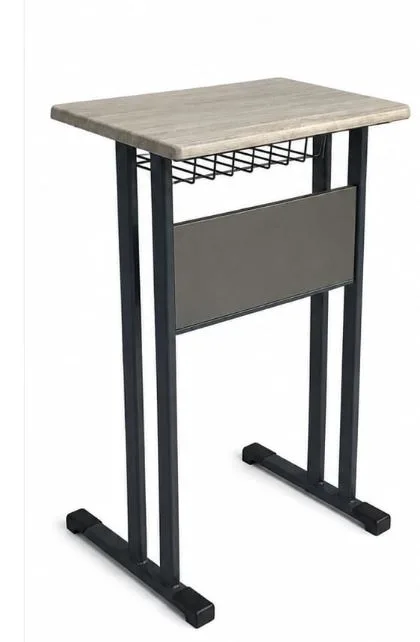
Dünya Teacher Lectern
Dünya teacher lectern: 45×63 Werzalit top, wire book rack beneath the top, flat panel front, upright twin tube profile frame and T-skid…
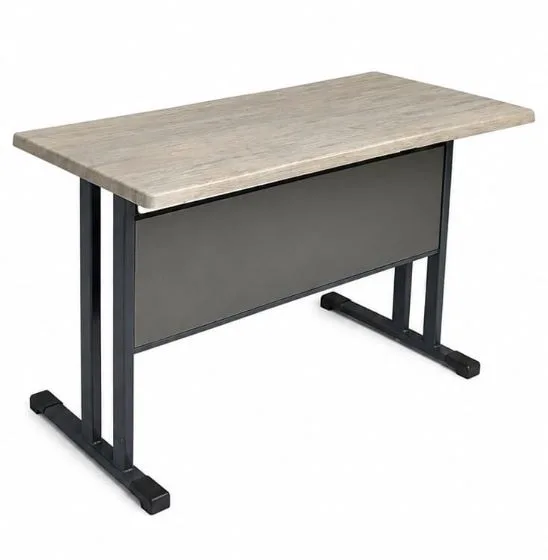
Dünya Teacher Desk
Dünya teacher desk: 60×110 melamine top, flat panel modesty screen, with drawer and an upright twin tube profile skeleton. For classrooms and…