



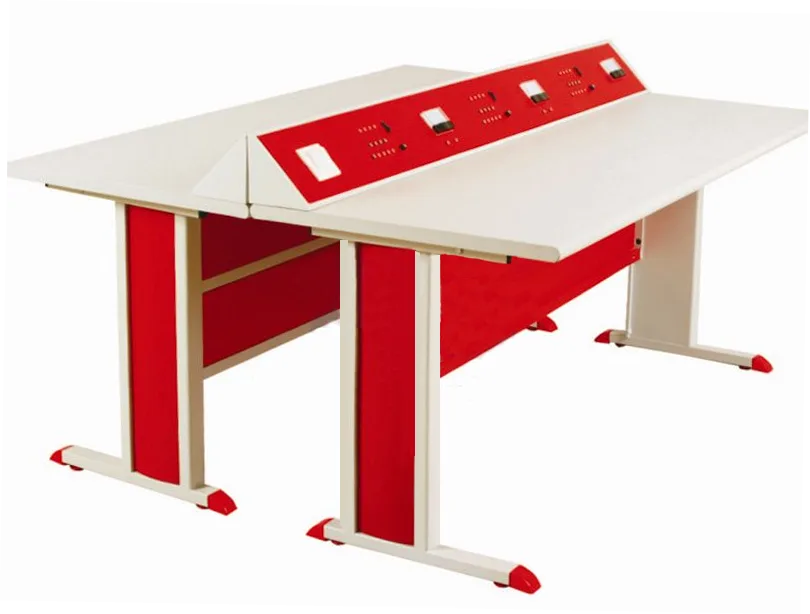
Physics Laboratory Table and Unit
Student table and under-unit for school physics laboratories: fibre or CDF top, flat and vibration-free work surface, powder-coated rigid frame.
- Working Layout
- Double sided — two facing student rows
- Electrical Panel
- Central panel; socket, switch and indicator groups integrated
- Panel Access
- Both sides — each student row has its own socket group
Free project survey Custom, quote-based pricing TSE / ISO 9001 certified production
Key Features
- Double-sided working layout — two facing student rows on one body
- Central electrical panel — socket, switch and indicator groups integrated into the body
- The panel serves both sides — each student row reaches its own socket group
- Fibre or CDF (compact) top — high density, flex-resistant flat surface
- Flat reference plane for measurement accuracy — critical in inclined plane, pendulum and optical bench work
- Rigid frame — does not twist under lateral pressure; no wobble to disturb an experiment
- Heat- and chemical-resistant surface — withstands electrolyte, oil, alcohol and solvents
- Coloured front panel — selected from the RAL chart
Product Description
The physics laboratory table and unit is designed to a different priority from its chemistry counterpart. Where chemistry is governed by chemical resistance, physics is governed by the flatness of the surface and the absence of vibration. Sırasan’s physics laboratory student table, with its fibre or CDF (compact) top option, addresses durability and measurement accuracy together.
Why is the table critical in a physics experiment?
Most experiments carried out in a physics laboratory rest on measurement: friction on an inclined plane, pendulum period, focal distance on an optical bench, force readings with a dynamometer. In all of them the table surface is a reference plane.
If the top flexes slightly in the middle, the inclined-plane angle differs from the one actually measured. If the table wobbles when pushed from the side, the swing in a pendulum experiment is disturbed and the student reads an incorrect period. An optical bench cannot be set up at all on a vibrating table. In a physics laboratory the table is therefore part of the measuring apparatus rather than merely furniture.
For this reason top flatness, frame rigidity and foot stability matter more here than in any other classroom furniture.
Top material: fibre and CDF
Fibre and CDF (compact) tops are homogeneous, high-density structures. Those two properties serve two separate purposes in a physics laboratory: density reduces flex in the top and preserves flatness, while the homogeneous structure ensures that no different layer appears beneath even if the surface is scratched.
Chemical contact also occurs in a physics laboratory — battery electrolyte, oil, alcohol and cleaning solvents are ordinary use. Fibre and CDF withstand these contacts. They are also heat resistant, so the surface is not damaged when a heater or hot metal component touches the table during thermal experiments.
The choice is made according to the laboratory’s usage intensity. Share the experiment set in your curriculum and we will say plainly which material will be sufficient.
Under-unit and experiment set storage
The greatest organisational problem in a physics laboratory is the experiment sets: dynamometers, weight sets, optical elements, cables and connectors are both numerous and small. A single lost component means that experiment cannot be run the following term.
The unit beneath the table provides compartmented, closed storage for the experiment set. Unit configuration — shelving, drawers, closed compartments and the need for locks — is determined per project according to how the laboratory is used. Keeping sets at the table shortens experiment preparation time noticeably.
Frame, stability and electricity
The frame is made from steel profile and finished with electrostatic powder coating. On a physics table the function of the frame is rigidity rather than appearance; it must not twist under lateral pressure. The feet carry impact-absorbing plastic glides which also damp small vibrations coming from the floor.
Whether an electrical connection is brought to the table is determined per project. In laboratories running electricity and circuit experiments, socket position, cable management and the need for a safety cut-out are part of the planning. Share your existing service plan and we will establish together how the table will be positioned.
Laboratory layout
Layout in a physics laboratory has two priorities. The first is sightlines: the teacher and the board must be visible from every table, because the pre-experiment explanation is delivered there. The second is working area: room must remain around the table when long apparatus such as an optical bench or inclined plane is set up.
Aisles between tables should be at least 100–120 cm so that two students working back to back do not collide. Share your laboratory dimensions and group size and we will prepare a layout proposal meeting these criteria.
Ordering, delivery and project support
The physics laboratory table and unit is produced on a project basis; quantity, top material, unit configuration and electrical integration are determined for your laboratory. Project surveys are free — share your laboratory dimensions, student numbers and experiment set and we will prepare a layout proposal together with a price quotation. Shipping is priced according to order volume and delivery province and is added to the quotation separately; it is not included in the price. We serve all of Türkiye and export abroad.
Production takes place at our own integrated facility in Ankara; metalwork, woodworking, coating and assembly are under one roof. If you are planning physics and chemistry laboratories in the same project, we can handle both spaces in a single quotation. All production complies with CE, TSE and ISO 9001 standards.
Double-sided layout and integrated electrical panel
The “unit” in this product’s name refers not to a storage cabinet underneath but to the electrical panel rising from the middle of the bench. Socket groups, switches and indicator or measurement points run along the panel; the supply needed for circuit and electricity experiments is directly on the bench. That removes extension leads and cables trailing across the floor — in a crowded laboratory, a direct safety gain.
The layout is double sided: two facing rows of students work on a single body and the panel serves both, each row reaching its own socket group. Twice as many students can work within the same floor area and a single supply line feeds both sides.
We recommend positioning the panel’s main breaker on the teacher’s side: being able to keep the power off outside experiment time is a basic safety measure in middle school laboratories. The number of socket groups, voltage requirements and breaker arrangement are determined together at project stage.
Models and Variants
| Model | Code | Description |
|---|---|---|
| Physics Table — Fibre Top | High-density fibre top. For laboratories with intensive experimental work where measurement precision is prominent. | |
| Physics Table — CDF (Compact) Top | Black-core compact structure; a balanced option between durability and budget. | |
| Under-unit Configuration | Project specific | Shelf, drawer, closed compartment and lock arrangement determined by the component structure of your experiment set. |
Frequently Asked Questions
Does a physics laboratory table differ from a chemistry one?
Their priorities differ. Chemistry is governed by chemical resistance; physics by the flatness of the surface and the absence of vibration. Most physics experiments rest on measurement and the table surface is a reference plane. The top materials may be similar, but on a physics table flatness, frame rigidity and foot stability come to the fore.
Does a wobbling table affect experiment results?
Yes, directly. If the table wobbles when pushed from the side, the swing in a pendulum experiment is disturbed and the student reads an incorrect period; an optical bench cannot be set up at all on a vibrating table. If the top flexes in the middle, the inclined-plane angle differs from the one actually measured. This is why frame rigidity and foot stability matter far more than appearance here.
Should we choose a fibre or a CDF top?
Both are homogeneous, high-density structures; both resist flex and preserve flatness. Fibre is preferred in laboratories with intensive experimental work where measurement precision is prominent. CDF is a balanced point between durability and budget. Share the experiment set in your curriculum and we will say plainly which is sufficient.
Is chemical resistance needed in a physics laboratory?
Yes, more than is generally assumed. Battery electrolyte, oil, alcohol and cleaning solvents are ordinary use in a physics laboratory. In thermal experiments a heater or hot metal component also touches the table. Fibre and CDF tops withstand both those chemical contacts and heat.
Where do we store the experiment sets?
That is exactly what the under-unit is for. The greatest organisational problem in a physics laboratory is the experiment sets: dynamometers, weight sets, optical elements and connectors are both numerous and small, and a single lost component means that experiment cannot be run the following term. The unit provides compartmented, closed storage, configured to your set's component structure.
Can an electrical connection be brought to the table?
Electrical integration is determined per project. In laboratories running circuit experiments, socket position, cable management and the need for a safety cut-out are part of the planning. Share your existing service plan and we will establish together how the table will be positioned.
How do delivery and assembly work, is shipping included?
We serve all of Türkiye and export abroad. Shipping is priced according to order volume and delivery province and is added to the quotation separately; it is not included in the price. Project surveys are free. If you are planning physics and chemistry laboratories in the same project, we can handle both spaces in a single quotation.
Other Groups in the Same Category
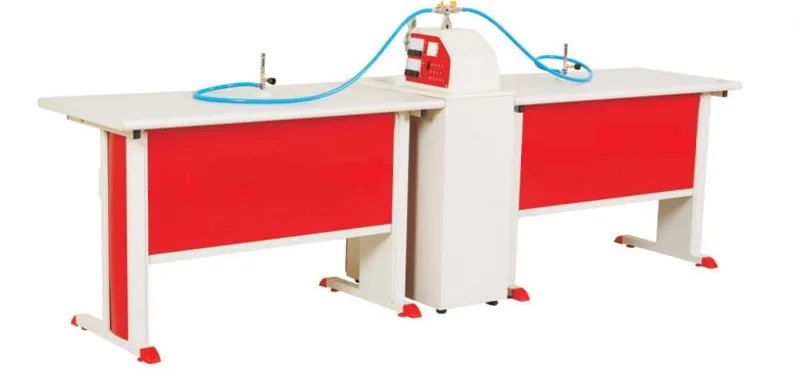
Chemistry Laboratory Table and Unit
Student table and under-unit for school chemistry laboratories: fibre or CDF chemical-resistant top, powder-coated frame, project-based production.