



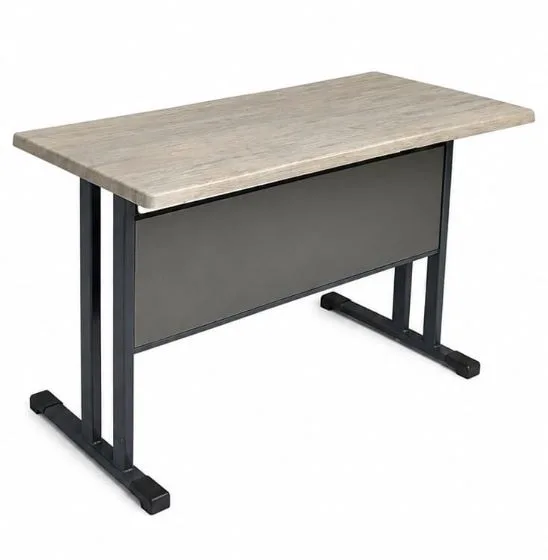
Dünya Teacher Desk
Product Code: MS 20
Dünya teacher desk: 60×110 melamine top, flat panel modesty screen, with drawer and an upright twin tube profile skeleton. For classrooms and offices.
- Product code
- MS 20
- Top size
- 60 × 110 cm
- Top material
- Melamine, banded edge
Free project survey Custom, quote-based pricing TSE / ISO 9001 certified production
Key Features
- Upright twin tube profile skeleton — load travels straight down the axis to the floor, no fatigue point forms
- T-shaped skid base — broad bearing surface, stable stance
- Flat panel modesty screen — hides the underside completely, gives a composed stance
- Construction with drawer — daily teaching material stays in order, the top surface stays clear
- 60×110 cm melamine top with banded edge — moisture does not enter through the cut face
- Closed surface: ink, chalk dust and liquid do not soak in
- A visual family with student desks using the same upright profile geometry
- Skeleton and panel colour chosen from the RAL chart
Product Description
The Dünya teacher desk is a teacher desk that puts sturdiness first with its upright twin tube profile skeleton, melamine top and flat panel modesty screen. Its drawer keeps daily teaching material in order. It is designed for institutions looking for a teacher desk with a modesty panel and prioritising a desk that stays equally solid for years.
Upright twin tube profile: why this skeleton?
There are two vertical tube profiles on each side of the desk, meeting the floor on a T-shaped skid base. That arrangement has a clear engineering logic: the load on the top travels straight down the axis of the profile to the floor. On curved frames the load produces a moment at the point of curvature, and that point is where fatigue starts over time; on an upright profile no such point forms.
A teacher desk is a piece of furniture loaded more heavily than student desks. Textbooks, a projector and stacks of paperwork are placed on it; people sit on its edge and lean on it. Over the years the sum of those loadings is the skeleton’s real test. The upright profile arrangement is a geometry better prepared for that test.
Using twin profiles adds something of its own. When two thin profiles are used side by side instead of one thick profile, the body’s resistance to torsion increases; when the desk is pushed from a corner the plane of the top tries to rotate, and that rotation is met by two separate profiles. Given how often teacher desks are moved within a room and pulled by an edge, that behaviour is felt directly in daily use.
Flat panel modesty screen and the teacher’s visibility
The modesty screen is produced as a flat panel rather than perforated sheet. That choice gives the desk a more closed and composed stance. Considering the desk’s position in the room, it is a deliberate selection: the desk is a reference point the teacher stands behind and runs the lesson from. A flat panel sharpens that reference and hides the clutter beneath the desk completely.
The front of the classroom is the first area looked at during parent visits and institutional presentations. A closed panel keeps the desk looking tidy at that point, because the visibility of material placed underneath disappears. The panel colour can be chosen to match the frame or from the same family as the top. The panel closing off the underside completely also keeps cables and sockets out of sight — in rooms using a projector and a computer, that is a quiet contribution to a tidy appearance.
Drawer and daily material order
The desk has a drawer. When the items a teacher reaches for dozens of times a day — the register, pens, markers, examination paperwork — are collected in the drawer, the top surface stays clear through the lesson. That is a more practical gain than it appears: a cluttered desk surface both narrows the teacher’s working area and affects the general appearance of the room.
Drawer capacity and the need for a lock vary from school to school. In institutions where examination paperwork is kept at the desk, a lockable solution may be needed; share that requirement before ordering and we can assess the suitable configuration together. In schools where each classroom has a lockable cupboard the drawer is generally sufficient for daily material, whereas in institutions where subject teachers move between rooms the storage requirement rises markedly.
Melamine top and surface durability
The top is melamine and measures 60×110 cm. The most important property of a melamine surface for a teacher desk is that it is closed: ink, chalk dust, marker marks and spilled liquid stay on the surface and do not soak in. It is cleaned by wiping with a damp cloth. The top edge is banded; the edge band protects the region of the top that takes the most impact and prevents moisture entering through the cut face.
On melamine tops the point that determines life is not the surface but the edge. The surface is closed and durable; but if the cut face is unprotected, moisture enters there, the panel swells and never returns to its former state. On a teacher desk the edge wears most along the front line — the teacher leans there all day, paperwork rubs against it, chairs knock into it. That is why band quality can be even more decisive than top thickness. We discuss this detail openly in the order conversation too.
Consistency with classroom furniture
This desk’s upright profile skeleton forms a visual family with student desks using the same geometry. When the whole room is built from one skeleton logic, the space looks unified. Colours are chosen from the RAL chart; using the same tone as the desks is the common preference, though producing the teacher desk deliberately in a different and darker tone is also an approach that emphasises the room’s focal point.
The consistency decision is not limited to colour. The same skeleton geometry repeating across every piece of furniture in the room gives the space a sense of planned order; rooms where different body logics are used together look uncomposed however clean they are. In school buildings that difference is felt particularly when looking in from the corridor. Share the frame type of your existing desks and we can determine together which teacher desk will speak the same language as that room.
Ordering, production and delivery
Top colour, skeleton and panel colour, drawer configuration and quantity are determined on the order. Production in one batch across the school matters for tone consistency. Our survey service is free of charge. The delivery charge is calculated according to order volume and destination province, shown as a separate item in the quotation, and is not included in the product price. If you are planning your delivery calendar around the start of the academic year, we recommend sharing that early.
Models and Variants
| Model | Code | Description |
|---|---|---|
| Dünya Teacher Desk — Desk Matched | MS 20 | Skeleton and panel colours produced in the same RAL tone as the upright-profile student desks in the room. |
| Dünya Teacher Desk — Contrast Build | MS 20 | The desk is deliberately produced in a different, darker tone from the student desks; the room's focal point is emphasised. |
| Dünya Teacher Desk — Administrative Use | MS 20 | With a neutral colour scheme for staff rooms and administrative areas; usable outside the classroom too. |
Frequently Asked Questions
What is the advantage of an upright profile skeleton?
The load on the top travels straight down the axis of the profile to the floor. On curved frames the load produces a moment at the point of curvature and fatigue starts there over time; on an upright profile no such point forms. Because a teacher desk is loaded more heavily than student desks, this difference in geometry becomes marked over the years.
Why is the modesty screen a flat panel rather than perforated?
A flat panel gives the desk a more closed and composed stance and hides the clutter beneath it completely. Because the front of the classroom is the first area looked at during parent visits and institutional presentations, this keeps the desk looking tidy at all times.
Can the drawer be lockable?
Drawer capacity and the need for a lock vary from school to school. In institutions where examination paperwork is kept at the desk a lockable solution may be needed; share that requirement before ordering and we will assess the suitable configuration together.
How is the top edge protected?
The top edge is banded. The edge band protects the region of the top that takes the most impact and prevents moisture entering through the cut face — on melamine tops wear almost always starts at unprotected edges.
Can we have the desk in the same colour as the classroom desks?
Yes. Colours are chosen from the RAL chart, and this desk's upright profile skeleton forms a visual family with student desks using the same geometry. Using the same tone is the common preference; producing the desk in a darker tone to emphasise the room's focal point is also possible.
Can it be used in the staff room too?
Yes. With a neutral colour scheme it is also used outside the classroom in staff rooms and administrative areas. Buying the same product for both classroom and administrative area simplifies supply and spare management.
How is the delivery time planned?
Production time varies with quantity and configuration; we give a firm date in the quotation. If you are planning your delivery calendar around the start of the academic year, we recommend sharing that early. The delivery charge is shown as a separate item in the quotation and is not included in the product price.
Other Groups in the Same Category
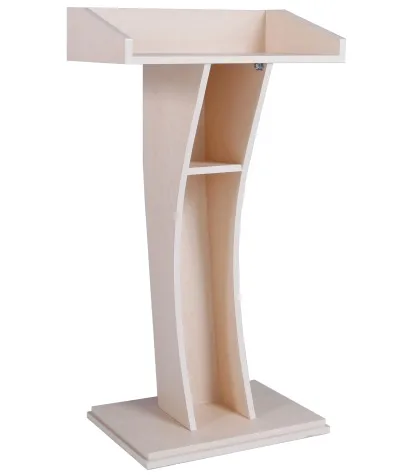
Wooden Speaker's Lectern
Wooden speaker's lectern: 18 mm MDF-lam body, forward-sloping reading surface and an internal lower shelf. For conference, ceremony and protocol areas. Code…
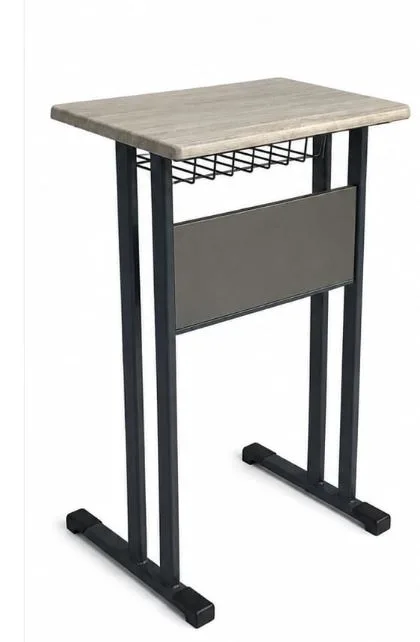
Dünya Teacher Lectern
Dünya teacher lectern: 45×63 Werzalit top, wire book rack beneath the top, flat panel front, upright twin tube profile frame and T-skid…
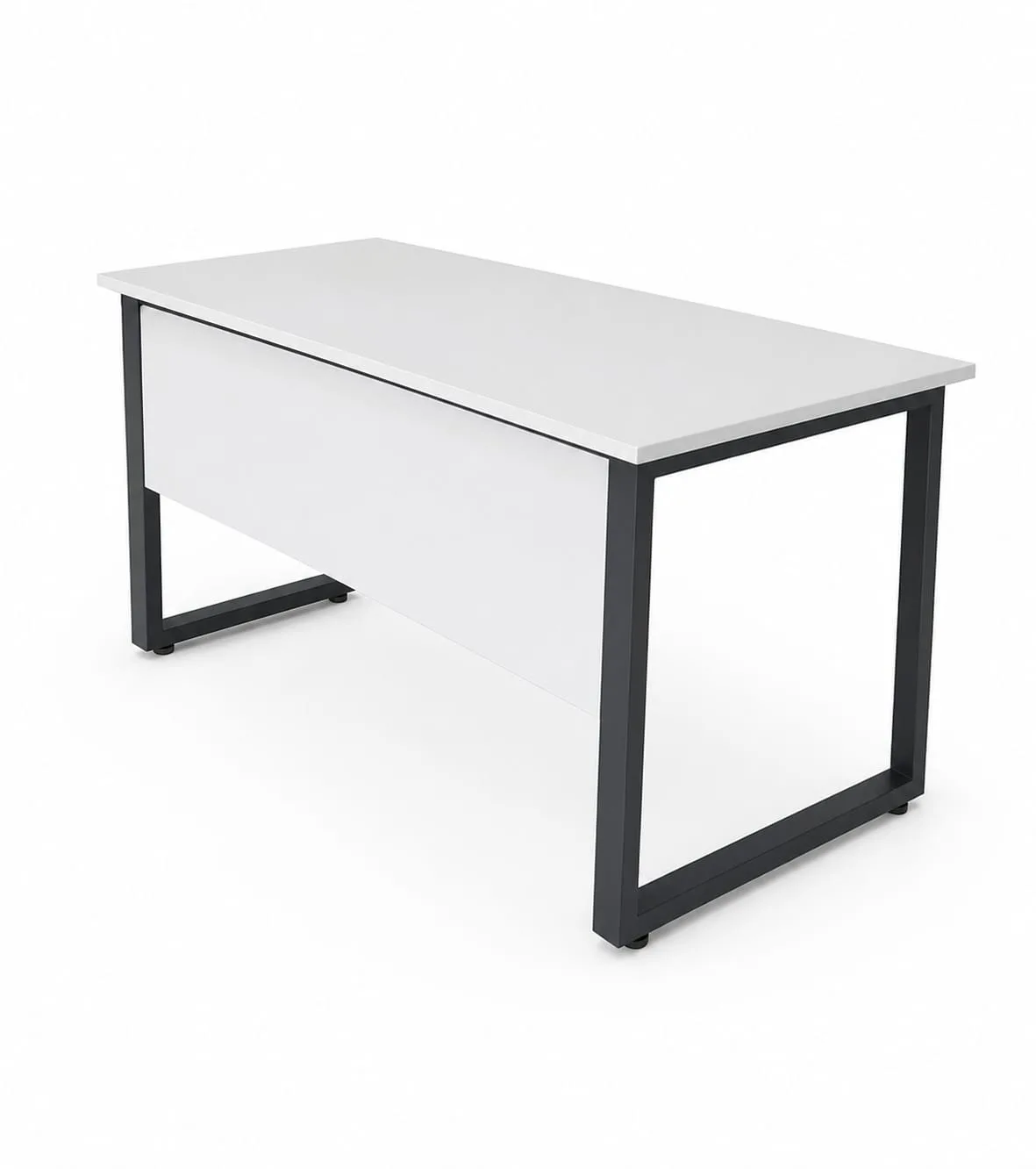
Leo Teacher Desk
Leo teacher desk: 60×110 cm melamine top, with drawer, closed-frame metal legs, flat modesty panel. For modern classrooms, staff rooms and administrative…